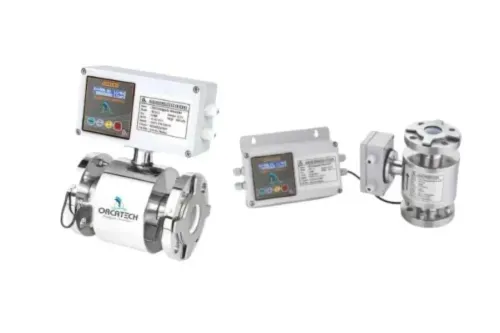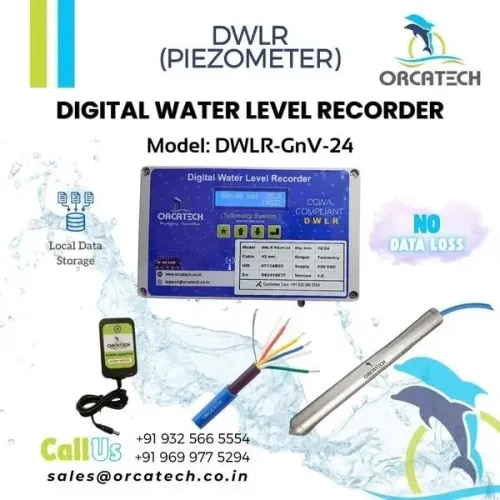
A factory needs to know which water point it is measuring, how the sensor is installed, and what happens to the record when power or network service fails. By the end, you will be able to define the required DWLR configuration, compare sensor and telemetry specifications, and prepare a commissioning checklist for a Pune manufacturing site.
Key takeaways
- Install the pressure transducer in a stable borewell or piezometer stilling arrangement.
- Specify accuracy, logging intervals, memory capacity and alarm rules before requesting quotes.
- Require stored readings and retransmission after network or power outages.
- Compare suppliers using calibration records, commissioning tests and telemetry evidence.
What DWLR-TGnV means at a Pune manufacturing site
A Digital Water Level Recorder (DWLR) measures water level against time, usually through a submersible pressure transducer installed in a borewell or piezometer. It is not automatically a flow meter, water-quality analyser or legally valid abstraction meter.
For dwlr tgnv for manufacturing water monitoring in pune, specify whether the reading means borewell depth, sump or tank level, or open-channel level; each uses a different hydraulic installation, reference datum and error assessment.
The labels below do not establish identical specifications. Require the supplier to expand “T” and “GnV” in writing, then provide the model-specific datasheet.
| Model label | Configuration distinction to verify | What it does not prove |
|---|---|---|
| DWLR-TGnV | A T-configured variant with the supplier’s defined GnV arrangement; confirm telemetry, power source, sensor and enclosure | That it measures flow or suits tanks without a suitable installation |
| DWLR-GnV-24 | A GnV-24 variant; confirm what “24” denotes, such as supply, logging or transmission configuration | Compatibility with a borewell, tank or 24-hour reporting |
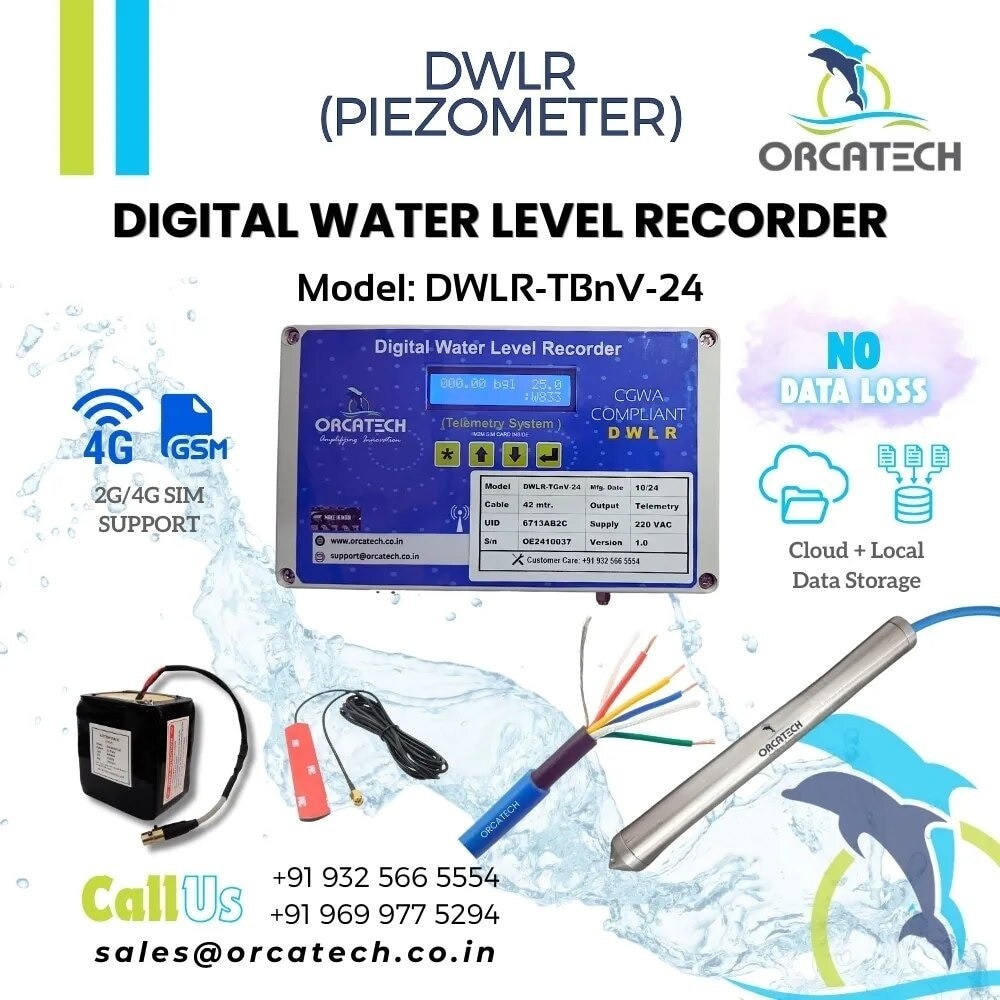
| DWLR-TBnV-24 | A battery-operated TBnV-24 variant; verify battery life, replacement method and outage memory | Continuous transmission during a power or cellular outage |
At a Pune factory, dwlr tgnv manufacturing must not be treated as one reading for the whole industrial area. Fractured Deccan basalt produces sharply different borewell levels over short distances.
A borewell recorder cannot replace a tank-level transmitter or bulk-flow meter, and telemetry alone does not satisfy Central Ground Water Authority or Maharashtra Pollution Control Board conditions.
Choose the measurement point, sensor and installation method
For factory water level monitoring in Pune, match the sensor to the water body, not to the recorder. A groundwater DWLR in a piezometer cannot replace a tank transmitter or bulk-flow meter: the hydraulic connection, reference datum and error sources differ.
| Measurement point | Sensor | Physical installation |
|---|---|---|
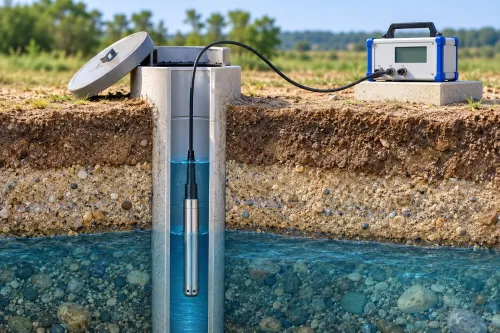
| Borewell | Submersible hydrostatic pressure transducer | Suspend it at a fixed depth inside a screened piezometer tube, keep it clear of the pump intake, and protect the cable from abrasion |
| Raw-water, process or overhead tank | Ultrasonic or radar level sensor | Mount above the highest level on a rigid bracket; aim through a clear path and record the tank-bottom datum |
| Open reservoir | Radar sensor or vented hydrostatic transducer | Mount radar above the surface, or place the transducer in a stilling well away from inlet turbulence |
| Wastewater storage | Non-contact radar for foam, vapour or sludge; hydrostatic sensor for a submerged reference point | Install radar on a cleaning-accessible bracket, or use a protected stilling tube that cannot clog |
For a borewell, log depth below the measuring-point datum and the datum’s elevation; do not mix depth below ground level with elevation above mean sea level. Deccan basalt fractures make nearby borewells behave differently, so one recorder does not represent the whole aquifer.
Use a stilling arrangement when waves or pump turbulence cause unstable readings. Keep every sensor serial number, cable depth and installation photograph with the site record. A wastewater sensor that fouls quickly is the wrong choice, even if its laboratory accuracy looks excellent.
Specify accuracy, timing, memory and alarm behaviour
Reject any quotation that says only “high accuracy.” Require the DWLR T GNV datasheet to state the measurement range, resolution, accuracy across that range, operating temperature, and reference datum. A borewell level recorder cannot replace a tank-level transmitter or bulk-flow meter.
| Parameter | Figure to require | Acceptance test or consequence |
|---|---|---|
| Accuracy | ± value in mm or % of full scale, with temperature and pressure conditions | Compare against a calibrated reference at low, mid and high points; an unqualified accuracy claim is not auditable |
| Timing | Sampling interval, transmission interval, timestamp source, time-zone setting and clock drift per month | Confirm that stored readings retain India Standard Time and that delayed packets remain distinguishable from new readings |
| Memory | Capacity in readings or days, record format, overwrite rule and battery-backed retention | Calculate storage for a cellular outage; full memory must trigger an alarm, not silently delete the oldest record |
| Alarms | High and low thresholds, deadband, delay, repeat interval, acknowledgement and communication-failure alarm | Test a threshold crossing and a missed transmission; unchanged readings must not masquerade as zero consumption |
Require a factory calibration record, sensor serial number, firmware version and export in CSV or another documented format. The supplier must explain how you correct a datum or calibration change while preserving the original record.
- Specify local buffering, retry count and retry interval for remote factory water monitoring.
- Require alarms for over-range, under-range, flatlined readings, low battery, sensor fault and missed packets.
- Obtain a written correction log; never accept software that silently rewrites historical values.
Design telemetry for outages and harsh factory conditions
A factory should specify store-and-forward telemetry, not live-only transmission. The recorder must write every reading with its timestamp to non-volatile memory before attempting delivery, so cellular loss, internet failure, SIM faults or congestion cannot erase evidence. Mark a missing packet as missing; never interpret it as zero or an unchanged level.
Specify these telemetry functions for remote factory water monitoring:
- State the communications path and coverage test location: cellular, LoRaWAN, Wi-Fi or another radio at the borewell, tank and control room.
- Require automatic retry with a documented interval, queue order and maximum outage-retention period.
- Require a power-fail timestamp, orderly shutdown and automatic resumption after power returns.
- Use a battery-backed recorder or UPS sized for the stated logging and transmission period, with surge protection, earthing and a protected power supply.
- Require UTC or India Standard Time handling, daylight-saving rules if relevant, and an export file that preserves the original timestamp.
- Require an alarm when memory, battery, signal or transmission queues reach defined limits.
For an industrial water recorder in Pune, specify an IP-rated enclosure, sealed cable glands, condensation control and protection from chemical vapour, washdown and electrical noise. Factory calibration records, sensor serial number and firmware version must travel with each export. A known datum or calibration change should create a correction record without silently rewriting earlier readings.
A borewell reading also describes that borewell, not every fracture-controlled aquifer nearby.
Commission the system and compare suppliers on evidence
Commission the recorder against a fixed reference, not against a dashboard reading. Confirm the sensor serial number, measurement point, cable routing, enclosure seal, power supply, cellular signal and local clock. Record whether each value means depth below measuring-point datum, elevation above mean sea level or depth below ground level.
A borewell piezometer cannot replace a tank transmitter or flow meter.
Ask the supplier for these records before acceptance:
- Factory calibration certificate showing date, range, accuracy and sensor serial number.
- Field-verification procedure using a surveyed reference and a known water level.
- Firmware version, time-zone setting, sampling interval and transmission interval.
- Non-volatile memory capacity and the maximum outage-retention period.
- Raw data export in CSV or another documented format, including timestamps, alarms and quality flags.
- A correction method that preserves the original record when the datum or calibration changes.
Evidence to compare suppliers:
| Evidence | Accept | Reject |
|---|---|---|
| Calibration | Signed certificate tied to the installed sensor | Certificate with no serial number |
| Datum control | Site datum, elevation and change history documented | “Water level” with no reference |
| Outage handling | Local records recover after power or network loss | Live-only readings |
| Volume measurement | Separate calibrated flow meter specification | Level trend presented as withdrawal volume |
For DWLR-TGnV for manufacturing water monitoring in Pune, ask Orcatech Enterprises how its export preserves original timestamps and corrected values. For factory water level monitoring in Pune, reject a single borewell record as representative of the wider aquifer. An industrial water recorder in Pune needs a separate flow meter when withdrawal volume matters.
Related product
 | Digital Water Level Recorder (DWLR) ₹62304 Digital Water Level Recorder, Telemetry with Local Data Storage, Grid Operated, Cloud Application, Digital Reporting View product → |
Frequently asked questions
What does DWLR-TGnV measure at a Pune manufacturing site?
A Digital Water Level Recorder measures water level against time, usually with a submersible pressure transducer in a borewell or piezometer. It is not automatically a flow meter, water-quality analyser or legally valid abstraction meter.
How should you choose the measurement point and installation method?
Select a borewell or piezometer that represents the water source or aquifer you need to monitor. Confirm the reference datum, usable depth, sensor pressure range, cable protection and access for inspection before installation.
What should a DWLR-TGnV specification include?
State measurement accuracy, logging interval, clock requirements, memory capacity, alarm thresholds, data transmission, outage storage and recovery behaviour. Ask suppliers to show these points in the technical submission.
How do you compare remote factory water-monitoring suppliers?
Request calibration records, sensor specifications, sample data exports, telemetry outage tests and commissioning results. Compare how each system stores readings, retransmits missed data and operates in dust, heat, electrical noise and weak mobile coverage.
Keywords